
TSF Methodology
Why AI Can’t Solve the Timing Problem
The entire discipline of time series forecasting exists to answer one question: “WHAT will the next number be?” The spectrum of forecast models from simple moving averages to complex machine learning and multi-variable neural network configurations represents variations on HOW to answer that question. The problem isn’t merely that this is the wrong question: you don’t need to know WHAT the next number will be; you need to know WHEN to act. The problem is that this question is impossible to answer with any degree of certainty — no matter how much AI you throw at it.
The Model of Temporal Inertia
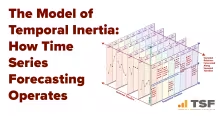
Newton’s First Law of Motion, the Law of Inertia, states that an object at rest remains at rest, and an object in motion remains in motion in constant speed and in a straight line unless acted on by an unbalanced force. The Model of Temporal Inertia proposes that the values of data organized in a time series will follow the same trend (speed and direction) until acted on by an unbalanced force. The Model of Temporal Inertia addresses each of the foundational problems that limit the confidence in classical time series forecasts. The Model of Temporal Inertia does not require stationary data and is able to generate forecasts with untransformed, raw data. Rather than isolating and discarding the random elements of data, the Model of Temporal Inertia captures those elements as seasonal relatives and forecasts when the effects of the unbalanced forces are expected to change.
Seasonal Models and a Microscope for Time
Think of the Model of Temporal Inertia as a Microscope for Time. When you view a drop of water through the lens of a microscope, you can see a world of single-cell organisms that are otherwise invisible. When you view time series data through the lens of the complex, irregular seasonal models that I’ve developed, you can see patterns and cycles that are otherwise invisible. Those patterns allow us to see further into the future with greater detail, precision, and confidence than possible with any existing tool. Each seasonal model is a lens in the Microscope for Time, revealing patterns of unbalanced force along the seasonal timeline.
TSF Forecast Pipeline Methodology
Every component of the TSF forecast pipeline observes a strict temporal separation: the inputs to any forecast for date t are derived exclusively from data that existed before date t. No future prices, no current-season accuracy metrics, and no contemporaneous actuals ever enter the computation of a forecast or its associated confidence interval. This document traces the exact data provenance at each stage to make that separation explicit.
TSF Research
Preregistered Methodologies
The Temporal Structural Forecasting research using stock market data is extensive and far-reaching. All of the research hypotheses and forecast methodologies have been preregistered on Zenodo in advance of analyzing any forecast data or results. These omnibus preregistrations are specifically designed to allow for multiple studies testing a full range of hypotheses and configurations on the same out-of-sample universe of 346 S&P500 stocks with sufficient historical data to generate 20 full years of forecasts.
Temporal Structural Forecasting: Evidence of Exploitable Temporal Structure in S&P 500 Equity Returns
This study tests whether temporal structure exists in equity price data and can be systematically exploited for position entry timing. Using a preregistered methodology, we generate specific limit order entry prices one week in advance for 346 S&P 500 constituents across all 11 GICS sectors. We test 1,386 parameter permutations over the 10-year period 2016–2025, encompassing 6 factor strategies, 7 forecast models, and 3 confidence thresholds.
Structural Integrity Across Market Shocks

This study subjects the TSF confidence interval framework to a rigorous structural integrity test across 14 major market disruptions spanning 17 years (2007–2024). The events range from sector-specific dislocations (the SVB bank failure) to global systemic crises (the Lehman Brothers bankruptcy and COVID-19 pandemic). For each event, we evaluate whether TSF’s 90% confidence intervals maintain their calibration—that is, whether realized prices remain within the predicted bounds at rates consistent with pre-shock baselines.
Factor Betas Are Path-Dependent Regression Artifacts: Falsifying Fama-French with 6,560 Controlled Experiments
Fama and French (1996) called momentum “the main embarrassment” of their three-factor model—the one timing anomaly their framework could not explain away. We demonstrate that this embarrassment was not an exception but a warning: the entire factor-based methodology for dismissing timing anomalies is invalid. Using 6,560 controlled experiments where paired portfolios hold identical stocks with identical weights entered on identical dates—differing only in exit timing—we show that factor loadings fail equivalence tests at an 86% rate.